LillyDirect, NovoCare, PfizerForAll: How to Choose the DTC Platforms of the Three Pharmaceutical Companies?
The U.S. healthcare system has long been criticized for its complexity. Patients often navigate multiple steps before receiving treatment: scheduling a physician visit, obtaining a prescription, verifying insurance coverage, coordinating with pharmacies, and sometimes managing prior authorization requirements. This process can take weeks, particularly for chronic diseases.
Since 2024, several major pharmaceutical companies have begun experimenting with a new model: direct-to-patient (DTP) digital platforms. These platforms integrate telemedicine, prescription management, and pharmacy delivery into a single online entry point.
Three of the most prominent initiatives are:
Eli Lilly and Company’s LillyDirect;
Novo Nordisk’s NovoCare Pharmacy;
Pfizer’s PfizerForAll;
All three platforms attempt to simplify healthcare access by connecting patients with physicians, prescriptions, and medications through digital services. However, they are not interchangeable solutions. Each platform reflects a distinct strategy regarding disease focus, pricing structure, and service scope.
Understanding these differences is essential for patients deciding which platform may be most suitable for their situation.
From Advertising to Infrastructure: Why Pharma Built These Platforms
For decades, pharmaceutical companies invested heavily in direct-to-consumer (DTC) advertising. Television commercials encouraged patients to “ask your doctor about” specific medications.
The emerging platforms represent a different concept: direct-to-patient infrastructure. Instead of simply promoting drugs, companies now attempt to organize the entire pathway from consultation to medication delivery.
Research from Galen Growth (2025) identifies five structural elements that define modern pharmaceutical DTP systems [1]:
Remote diagnosis;
Telehealth consultations;
Online pharmacy and distribution;
Disease-management services;
Insurance and affordability tools;
Platforms that combine these components can significantly reduce “time-to-therapy,” sometimes shortening the process from several weeks to only a few days.
Two additional forces accelerated this shift.
1. Explosive Demand for GLP-1 Therapies
Medications targeting the GLP-1 receptor pathway, originally developed for diabetes, are now widely used for weight management. Clinical trials have shown significant weight-loss effects and improvements in cardiometabolic risk factors [2].
Large observational research involving 2.5 million U.S. veterans suggests that GLP-1 therapies may influence risk profiles across more than 170 diseases, including neurocognitive and cardiovascular conditions [3]. Although these findings remain under investigation, they highlight the broader clinical significance of cardiometabolic health.
Demand for drugs such as Zepbound, Mounjaro, Wegovy, and Ozempic has increased dramatically.
However, insurance coverage for obesity treatment remains inconsistent. Many patients pay out of pocket, prompting pharmaceutical companies to explore direct pricing and distribution channels.
2. Digital Healthcare After the Pandemic
Telemedicine expanded rapidly during the COVID-19 pandemic. Today, remote consultations are widely accepted for managing chronic diseases such as diabetes, migraine, and obesity.
Digital healthcare infrastructure now makes it feasible to connect consultation → prescription → delivery through a single online interface.
Three Platforms, Three Strategies
Although LillyDirect, NovoCare, and PfizerForAll all aim to simplify medical access, their strategic models differ.
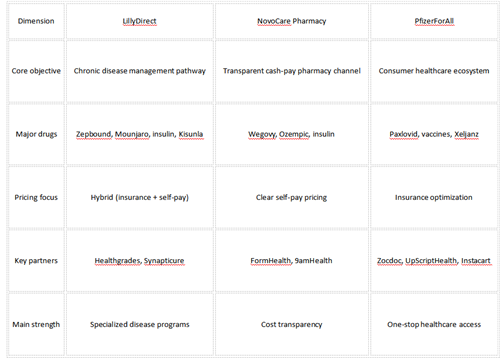
These differences reflect three distinct visions of how pharmaceutical companies may interact with patients.

LillyDirect: A Disease-Pathway Platform
LillyDirect, launched in 2024 by Eli Lilly and Company, is designed as a disease-focused care pathway.
Instead of functioning primarily as an online pharmacy, the platform organizes services around specific medical conditions.
Key Therapeutic Areas
The platform currently focuses on several areas:
obesity and metabolic disease;
Diabetes;
Migraine;
Alzheimer’s disease;
For example, patients interested in weight-management therapy may eventually receive prescriptions for medications such as Zepbound or Mounjaro after consultation with an independent clinician.
Alzheimer’s Care Integration
A recent expansion connects patients with neurologists through Synapticure, enabling remote evaluation and specialist referrals for Alzheimer’s disease.
This integration is particularly relevant because neurological care shortages remain a significant barrier in many regions of the United States.
Pricing Model
For self-pay patients, the starting price for Zepbound through LillyDirect is approximately $349 per month for certain dosage levels.
Insurance patients may access prescriptions through third-party pharmacy networks integrated into the platform.
Service Characteristics
Physician discovery via Healthgrades
Telehealth partnerships with metabolic care providers
Direct medication purchase for cash-pay patients
Pharmacy fulfillment through partners such as Amazon Pharmacy
Strategic Significance
Industry analysts describe LillyDirect as a “full-stack healthcare pathway”, covering all five DTP components: diagnosis, telehealth, pharmacy distribution, disease management, and insurance support [1].
In economic terms, the platform functions as a demand center for cardiometabolic healthcare. By connecting clinical services, diagnostics, and treatment options, it attempts to build a larger ecosystem around chronic disease management.
NovoCare Pharmacy: A Pricing-Focused Access Model
NovoCare Pharmacy, developed by Novo Nordisk, takes a different approach.
Rather than building a comprehensive care ecosystem, NovoCare focuses primarily on transparent medication pricing and direct purchasing options.
Core Therapeutic Focus
The platform centers on two major drugs:
Wegovy;
Ozempic;
Both medications belong to the GLP-1 receptor agonist class.
Pricing Strategy
NovoCare emphasizes predictable pricing for self-pay patients.
Examples include:
Wegovy: $499 per month for cash-pay patients
Promotional offer: first two months $199 per month for new users (available until March 31, 2026)
For insured patients, Ozempic may cost as little as $25 for a three-month supply, depending on eligibility and co-payment assistance programs.
Service Model
NovoCare provides several operational features:
telehealth referrals through platforms such as Form Health and 9amHealth;
case-manager assistance for prescription coordination;
medication delivery or pharmacy pickup options;
Strategic Logic
Unlike LillyDirect’s ecosystem model, NovoCare operates primarily as a manufacturer-controlled pharmacy channel.
Its central goal is to stabilize access to high-demand medications while offering transparent cash pricing.
This strategy may appeal particularly to patients who:
already have a physician;
understand the medication they need;
want predictable out-of-pocket costs;
PfizerForAll: A Consumer Healthcare Ecosystem
PfizerForAll, developed by Pfizer, represents a third model: a broad digital healthcare marketplace.
Instead of focusing on specific disease pathways or single drug categories, the platform offers a wide range of everyday healthcare services.
Examples of Covered Treatments
These include:
COVID-19 treatment with Paxlovid;
migraine therapies;
Vaccines;
specialty drugs such as Xeljanz for rheumatoid arthritis;
Platform Features
PfizerForAll integrates multiple digital health partners.
Patients can:
schedule appointments through Zocdoc;
receive telehealth consultations via UpScriptHealth;
order medication delivery through Instacart or partner pharmacies;
The platform also provides tools for checking vaccine eligibility and scheduling immunization appointments.
Pricing Model
PfizerForAll does not directly sell most medications. Instead, it helps patients find:
insurance coverage;
co-payment cards;
manufacturer discount programs;
Telehealth consultations may cost around $35 for a remote visit.
Strategic Orientation
PfizerForAll prioritizes convenience and service aggregation.
In contrast to LillyDirect’s specialized disease pathways or NovoCare’s price-focused pharmacy channel, PfizerForAll resembles a consumer healthcare hub similar to a digital marketplace.
How to Choose Between the Platforms?
Because these platforms address different needs, the best choice depends on individual circumstances.
1. Price-Sensitive Self-Pay Patients Seeking GLP-1 Therapy
If the goal is to obtain Wegovy or Ozempic at predictable cash prices, NovoCare may be the most direct option.
The platform’s promotional pricing—such as the $199 introductory offer for Wegovy until March 31, 2026—can significantly reduce initial costs.
2. Patients Seeking a Comprehensive One-Stop Service
If convenience is the priority, PfizerForAll may be preferable.
Its integration of appointment booking, telehealth consultations, pharmacy delivery, and vaccine scheduling creates a digital healthcare experience similar to modern consumer services.
3. Patients With Specialized Medical Needs
Individuals seeking treatment for complex conditions—such as Alzheimer’s disease—or those interested in Zepbound-based weight management may benefit from LillyDirect.
The platform’s structured disease pathways and specialist referral network can be valuable when medical expertise is limited locally.
4. Patients With Commercial Insurance
For insured individuals, LillyDirect and PfizerForAll may provide better support for navigating insurance benefits.
These platforms help identify co-payment assistance programs and pharmacy networks that reduce out-of-pocket costs.
Important Considerations Before Using These Platforms
Although these services can simplify healthcare access, several practical points deserve attention.
A Prescription Is Always Required
None of the platforms sell prescription medications without medical evaluation. Patients must obtain prescriptions either through platform-connected telehealth providers or their existing physicians.
Prices Can Still Be High
Even discounted prices—such as $349 per month for Zepbound or $499 for Wegovy—remain expensive for many households.
Health economists from Harvard Medical School have noted that such discounts may represent short-term affordability solutions rather than structural reform of drug pricing.
Platform Offerings Change Quickly
Because these ecosystems are expanding rapidly, drug lists, partners, and pricing models may change frequently. Checking each platform’s latest information is recommended before making decisions.
The Larger Transformation: Pharmaceutical Ecosystems
Beyond individual patient decisions, these platforms illustrate a broader transformation in healthcare strategy.
Pharmaceutical companies are no longer simply drug manufacturers. Increasingly, they are attempting to orchestrate patient journeys.
This shift reflects a new form of competition: not only developing effective medications, but also designing integrated healthcare ecosystems.
Some analysts describe LillyDirect’s approach as “progressive integration”, where connected services—telehealth, nutrition support, diagnostics, and pharmacy delivery—gradually expand into a self-reinforcing healthcare network.
Other models, such as NovoCare and PfizerForAll, represent different points along the same evolution.
The outcome remains uncertain, but one trend appears clear: healthcare access is increasingly shaped by digital platforms rather than isolated institutions.
Conclusion
LillyDirect, NovoCare Pharmacy, and PfizerForAll all aim to simplify the complex medical processes that patients often face in the United States. However, they reflect three distinct models of digital healthcare delivery.
LillyDirect focuses on specialized disease management pathways.
NovoCare Pharmacy emphasizes transparent cash-pay pricing for high-demand therapies.
PfizerForAll provides a broad consumer healthcare ecosystem combining telehealth, prescriptions, and preventive services.
Rather than competing in exactly the same way, these platforms illustrate different strategies for connecting pharmaceutical companies directly with patients.
For individuals navigating treatment options, the most useful approach is to consider medical needs, insurance coverage, and service preferences. The platform that best aligns with these factors is likely to provide the most practical value.
References:
[1] Galen Growth Research. (2025). Pharma’s Direct-to-Patient Pivot: LillyDirect, PfizerForAll & NovoCare Models. https://www.galengrowth.com
[2] Jastreboff, A. M., et al. (2022). Tirzepatide once weekly for the treatment of obesity. New England Journal of Medicine, 387(3), 205–216. https://doi.org/10.1056/NEJMoa2206038
[3] Al-Aly, Z., et al. (2024). GLP-1 receptor agonists and health outcomes across multiple disease systems. Nature Medicine, 30, 1234–1242. https://www.nature.com/articles/s41591-024-XXXXX
[4] Eli Lilly and Company. (2024). Lilly launches LillyDirect digital healthcare platform. https://investor.lilly.com
[5] Novo Nordisk. (2025). NovoCare Pharmacy expands access to Wegovy and Ozempic. https://www.novonordisk.com
Author Information
Dr. Benjamin Lawson is a physician and health policy analyst specializing in pharmaceutical innovation, healthcare access, and digital health platforms. He received his MD from Northwestern University Feinberg School of Medicine and a Master of Public Health from the University of North Carolina at Chapel Hill. His work focuses on how emerging healthcare delivery models—such as telemedicine services, direct-to-patient pharmaceutical platforms, and digital care ecosystems—affect treatment accessibility, medication adherence, and healthcare costs. Dr. Lawson has contributed to several health policy analyses and medical science communication projects aimed at helping the public understand complex developments in modern healthcare systems.
Disclaimer
This article is intended for educational and science communication purposes only. It does not provide medical advice, diagnosis, or treatment recommendations. Healthcare decisions should be made in consultation with licensed medical professionals. Information about digital health platforms, medications, and pricing programs may change as companies update services or regulatory policies evolve.
Recommended for you: